Tuesday, April 24, 2012

Homegrown tomato connections


M R Gardens 2009 harvest
Seed saver profile: Jean Taylor
...And M R Gardens tomato selection for 2012

"What'd life be without homegrown tomatoes?
Only two things that money can't buy...
That's true love & homegrown tomatoes..."

Three things come to mind when I think of tomatoes. 1) The lyrics to Ray Clark's song "Homegrown Tomatoes" (also covered by John Denver); 2) The taste of the first ripe heirloom tomato of the season, alongside mozzarella cheese, basil and balsamic vinaigrette, and sprinkled with pepper; and 3) Jean Taylor of Taylor's Greenhouse in Robbinsville, NC. 

Jean Taylor, Robbinsville NC
I got to know Jean in 2010 while I managed the WNC AgOptions program.  A woman of few words and a big heart, Jean epitomizes the unassuming yet proud nature of many farmers and gardeners I have met in the Appalachian Mountains. Her nursery tucked in the hills of Graham County attracts big crowds with just a few advertisements in the local newspapers. She told me about how a coveted tomato variety "didn’t last like a June frost" and about how "taird" she is by the close of nursery season in July. (I enjoyed hearing her Appalachian pronunciation, for in my family's rural Ohio speak, "taird" means really really tired.) 

Excited about how WNC AgOptions helped her grow her business, Jean sent me home from her nursery with a handful of flower and vegetable plants to thank me for my work. Her generosity continued long after the heat of tomato weather had passed, even though 100 miles separates us. Several months after I had visited her, I returned home after a hectic day in the office to find a package with a return address of Robbinsville on my doorstep. Jean had mailed me a homemade wreath, arranged with evergreen branches and other greenery. The Christmas gift reminded me why I invested so much energy and so many hours into the program—so that operations like hers continue.

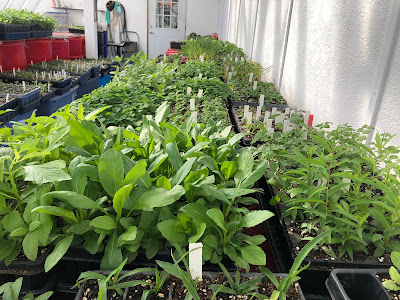
M R Gardens 2012 seedlings
Jean and I continued to keep in touch, and she graciously shared some of the rare heirloom seeds she collects from growers throughout the Nantahala area. This tradition of sharing seeds not only preserves history and ensures that the tastiest vegetables survive, but it also maintains connections between gardeners. Now Jean Taylor is not only connected to me, but to all of my customers who have an heirloom tomato from her seeds in their backyards, and enjoy the unforgettable flavor of the season's first ripe tomato.

Below are descriptions of the tomatoes and peppers that I currently have available. Note that the tomato plants are indeterminate, which means the plants climb up to 10 feet, so they need to be trellised and most likely suckered.


HEIRLOOM TOMATOES

Cherokee Purple
Cherokee Purple is a variety originally from the Tennessee area that was cultivated by the Cherokees. The productive plants produce dusky rose to purple colored, 12 oz. - 1 lb. fruits. The tomato's rich, complex and sweet flavors make it a popular market variety. See more information here.

Oxheart
Oxheart produces large, deep pink heart-shaped fruits that have few seeds and a sweet, rich, complex flavor. The tomatoes are meaty while also juicy. The variety was originally brought over from Russia. Read more about the tomato.


Ruby Orr
Ruby Orr is a variety typically only found in Southwestern North Carolina. It is similar to German Johnsons in size and shape. It produces a meaty, flavorful, sometimes knotty fruit that turns pink with yellow shoulders when mature. It is excellent for BLTs.

Yellow Roma is a unique variety that retains the great flavor of the Roma but has an exotic color. It is very productive all season. The thick wall of the small oblong Roma makes it the perfect tomato for home-canned salsa, sauces and catsup. 

Arkansas Traveler
Arkansas Traveler is a 100-year-old southern heirloom variety that produces well in hot weather, humidity or drought as it is highly resistant to cracking and disease. The smooth, rounded rose-colored tomatoes are 6-8 oz. and very flavorful and sweet. Here's a guide for the tomato.
 
HYBRID TOMATOES

Cherry Tomatoes
Sweet One Million Cherry produces high yields of super-sweet bite-size tomatoes that have excellent, hybrid disease resistance. The large vigorous plant has long chains of smooth, dark red, 1 to 1.5" fruits. It matures nicely and continues producing until frost.


HEIRLOOM OR OPEN POLLINATED PEPPERS

Gamba
Gamba is a green bell pepper that turns red if left on the plant long enough. It excels as a frying or stuffing pepper. The thick, meaty flesh holds up well and sweetens during cooking. It produces flattened bells, 3" in diameter and 1.5" deep with rich red color.

Corno Di Taro is an Italian variety. The tall plant produces large amounts of narrow, slightly curved 8-10" long fruits. It is best roasted or fried.

Sweet Big Red
Sweet Big Red is a high yielding variety that produces a sweet, thick-fleshed bell that ripens green to red.

Golden Treasure
Golden Treasure is an Italian variety, excellent for frying, roasting and fresh eating. Long, 9" fruits ripen from green to shiny yellow. Sweet flavor with medium thick flesh and tender skin.

HYBRID PEPPER

Golden Summer is a yellow mild and sweet pepper with exceptionally thick walls. It starts out lime-green, then turns a sunny gold at maturity.
---
Email M R Gardens at gardens@wncmretc.com or call 828.333.4151 to make an order or request a full plant list. All plants are grown in organic potting soil. M R Gardens sells on a sliding scale so that all people in the community can enjoy healthily grown plants. You can also stop at her Plant Wagon in Oakley, which is typically open Saturdays in April and May.


Thursday, April 5, 2012

The pace of natural life


Throughout my life, the therapeutic benefits of gardening have improved my quality of life tremendously—especially in this era of transition, change and movement. The fresh air, feel of the soil and sight of the seedlings arriving to the world are all incredibly calming to me. Nights of deep, uninterrupted sleep—thanks to the physical labor needed to maintain a spring garden—remind me of another reason of why I farm.

Perhaps the reason why I appreciate gardening the most is that it has taught me patience, which corresponds to many other areas of my life, including my business and relationships. Waiting for seeds to emerge, tomatoes to ripen, and asparagus to be harvested (that takes three years of patience!) has opened my eyes to the slower pace of natural life.

Over a recent potluck dinner, I discussed with friends my discovery of how long it takes for visions to be realized. They too are small business owners and independent contractors and know well the frustration of wanting to move quickly through their goals, although the realistic pace is much slower than they expected. Often in the first year of business, owners spend just as much time shutting doors as they do opening windows.

Working in the garden—when there's often only a month timespan to get it right until next year—helps me realize how good ideas take time to become reality. If we have patience, the long-awaited rewards are appreciated even more so than if they had manifested immediately.

This spring, I learned yet more lessons from the garden—flexibility, efficiency and speed when the time is right. I had to move at the pace of a tornado this spring as the May-like weather in March had me weeding and mulching in areas that I usually don't touch until late April. I rearranged my garden plan, so that the heat-sensitive crops would claim the part-shade area that I usually reserve for summer greens.

As business owners, we must be prepared to run when the situation demands. Since we've spent all that time in patience, movement should not be too much of a burden. But if we've been chasing our tails before we even left the starting blocks, then having enough energy to reach the finish line will be a challenge.

Sometimes there's an ecological need for violent storms. But for the most part, I equate health with ease, calm, predictability and a sustainable pace. If we're operating any other way—that usually means something is out of balance.

I try not to worry too much about the Earth's imbalance that caused this early summer weather. Instead, I will enjoy the blueberries and strawberries that are already appearing, a good month ahead of schedule. I trust the Earth is returning to balance at its own pace.

However, the Earth's health is dependent on us, as we relearn balance, moderation and a slower pace of life. I am much more worried about that not happening.

I hope you are experiencing balance in the garden this spring.

Wednesday, February 8, 2012

Time to request 2012 plant list


Pre-ordering encourages planning instead of impulse buying.


When shopping for your garden starts, how many times have you felt so enticed to buy a plant that you couldn't resist, but then once you got it home, you didn't have the space for it or the time to plant it? (I admit, that's happened to me more than once).

Or were you so overwhelmed by the hundreds of choices at the market or retail store that you couldn't decide which ones to take home?

Pre-ordering alleviates some of the stress and impulsiveness of buying and saves you money.  It helps you in purchasing plants specific to your body's requirements as you have time to think about the nutrients you need and, correspondingly, the vitamins and minerals in the vegetables. You can also thoughtfully purchase the proper plant companions so that the vegetables are growing in the right garden community and are appropriate for your garden environment.

M R Gardens encourages gardeners to be thoughtful in their garden planning by offering customers the option of ordering them ahead of time. The list of plants that M R Gardens is offering for sale in 2012 is now available.

When you request a list — by emailing me at gardens@wncmretc.com — you'll see which varieties I have on-hand, read their descriptions and see who collected the seed. You'll then make a notation of the number of plants you want on the spreadsheet. Please return the completed order by February 1 for spring crops and by March 15 for summer crops. If I don't have a variety that you are hoping to grow, please let me know and I may be able to find it for you.

My spring crops (order due on February 1) include broccoli, cabbage, kale, spinach, mustard, lettuce, celeriac and leeks.  Summer crops (order due on March 15), include eggplant, sweet peppers, summer and winter squash, tomatoes, watermelon and chard.  I also have culinary herbs—five types of basil, catmint, dill, fennel, parsley— and beneficial flowers such as borage, calendula, cosmos, nasturtium, scarlet runner bean, and sunflowers. Please also order herbs and flowers by March 15.

I'm especially excited about trying heirloom varieties from Nancy Long, a seed collector from the Cherokee Indian Reservation. I have seed for Black Seeded Simpson lettuce, Giant Curled mustard, Early Prolific Straightneck squash and Moon and Stars watermelon. Slow Food USA describes this variety of watermelon as a "magical" melon: "The dark green and yellow speckled skin of the Moon and Stars watermelon evokes a living galaxy while its happenstance return suggests a storybook ending."

I hope pre-ordering helps you have a magical 2012 in the garden. Contact me today!
---
Email M R Gardens at gardens@wncmretc.com or call 828.333.4151 to request a plant list. All plants are grown in organic potting soil. M R Gardens sells on a sliding scale so that all people in the community can enjoy healthily grown plants.

Friday, January 6, 2012

The gift of books: For winter reading


The gardening energy starts to sprout soon after the New Year. We've had some downtime after the holidays and have reflected on how we want our garden to improve. A few sunny days get us excited for spring, although we can't break into the soil for another three months. So what can we do with that energy? We curl up beside the fireplace with a cup of tea in one hand and a book in the other, and plan next year's garden.

When the gardening energy motivated me to enter the agriculture profession in 2003, I gave my family a list of titles I wanted to add to my library and asked them to get me nothing else but what was on the list for Christmas. They graciously obliged despite their raised eyebrows.

So, in part thanks to them, I now have quite the extensive library. The list of resources below is just the tip of the iceberg of my own library, let alone of all the good gardening manuals in existence.

I don't pretend to have memorized all of the information in these resources. I tend to keep in my brain the name of the author, the title or the website where I can find the answer, rather than the actual answer. Meanwhile, the knowledge that I need to make minute-by-minute decisions in the garden is in my muscle memory. (I tell you these secrets to give those intuitive, non-scientific people out there some confidence: You CAN produce a large quantity of beautiful, quality vegetables despite what can feel like poor rote memorization skills.)

It's also important to keep in mind that the best gardening resources are often your neighbors. I'm thrilled my neighbor Essie recently started the Blue Ridge Garden Form on Facebook so that area gardeners can better communicate. In this hilly, twisting, winding region of ours, there's so many different microclimates that the right move in one neighborhood may be entirely different in the next. The more we share our experiences, the better gardeners we can become.

And of course, it's important to remember that the best way to learn is by doing. Don't get too overwhelmed by the amount of information, opinions and gardening methods out there. Only when you have solved the problem yourself will the answer truly be imbedded in your mind. So once the soil has warmed (which may be as early as late February in parts of the Blue Ridge if you use season extension techniques), get out there and give it a go!

Monday, November 7, 2011

Therapeutic benefits of physical work


Deck cleaning produces suds like waves washing on shore
Suds trickled from the sponge in my hand and mixed with the water surrounding me. The frothy water moved up and around me, like a wave washing onto shore, before dripping off the deck.
As I watched the suds rinse away mildew stains, I felt a release of tension, which had built in my body after hardship had inflicted my family's life and my own life the last two months. A long list of disappointments, ranging from just annoying to utterly tragic, had left my family feeling like the only light at the end of the tunnel was a train coming full speed toward us.
My thoughts seemed to move from out of my head through my shoulders to my arms to my hands to the sponge to the suds to the water and dripped to the ground 15 feet below me. With that release went sadness, and mental clarity took its place.
A looming house appraisal required for a refinance forced me to scrub the deck, a task I had avoided for a year. But once I started scrubbing mildew off the deck floor, I only felt better and better. The therapeutic benefits of physical work turned a chore into a needed emotional release.
The activity reminded me why I have structured my lifestyle to include physical work. The needs of my large garden keep me moving throughout the year. Our bodies hold tension as we overthink and become needlessly stressed in our busy lives. As we work in the garden, those points of tension release.

Wednesday, September 7, 2011

No machine needed: Worms do the tilling


"I'm never going back to my old way of gardening!" My neighbor recently said to me. "Building the soil the top down makes much mores sense. My garden was so much more productive and easier to maintain. I did almost no weeding this year!" She thanked me profusely for showing her my method of gardening, which requires no mechanical tilling.
Spring garden—no mechanical tilling needed
            For the past two years I watched my neighbor diligently till her garden, and then struggle with weeds, plant disease and nutrient-related issues. At first, I remained quiet.
I typically don't suggest new gardening methods unless someone asks for my advice. Gardening is good, no matter what methods people choose, so I won't critique or try to convert until they ask. It's important that people find the gardening system that works best for their personalities, work styles, schedules and local surroundings.
I am not a gardening purist. My agricultural mentors are so diverse that I borrow concepts and draw tips from a wide variety of methods, including Lee Reich's Weedless Gardening, EliotColeman's Four Season farming, Ruth Stout's no-dig method, Patricia Lanza's lasagna gardening and John Jeavons' Biointensive mini-farming. I don't follow any one of these philosophies to an absolute T, but instead pick and choose what makes most sense for my location, goals and values.
Straw mulch on garlic
I admit—my spine does shiver like someone ran fingernails down a blackboard when I see a tiller break open ground. I can't help but want to protect the soil structure—the key to good soil tilth. Healthy soil is the foundation of the Earth's health—and therefore our health—on so many levels.
But I remain quiet until people ask.
So was the case with my neighbor, until she repeatedly exclaimed about the quality of my produce and beauty of my garden. How do I do it? She wanted to know.
It all boils down to soil tilth, I explained. A simple test with a digging fork showed her the impact of tilling. When I drove the fork into her garden, the prongs barely sunk so that they were only halfway underground.
Then we walked across the street to my garden. My foot barely exerted any pressure as I pressed the fork into the soil, and the prongs quickly disappeared underground. I then lifted the dirt with the fork, careful to not to disrupt the soil layers as I did so. The moist soil fell off the fork in small loose clumps.

Monday, June 20, 2011

Why I garden: My growing list


  1. While gardening, I gain inspiration for writing and other projects and find solutions to issues I'm facing.
  2. When I need a break from the computer in the middle of the day, I can go pick raspberries.
  3. The garden is a way to give back to my community by donating excess food to organizations and trading over the fence line with neighbors.
  4. My edible yard adds to the aesthetics and diversity of my community. Neighbors frequently remark on it.
  5. When I'm overwhelmed by the overload of information and activity of modern life, or just plain tired from travel, my garden is a place of rejuvenation.
  6. In our busy lives, we often forget the speed that the world is meant to operate. The garden — and the kitchen, where I peel, pickle and can — is a place to relearn a slower pace.
  7. The garden teaches me to appreciate the simple things, as well as helps me understand the complexities.
  8. The garden toughens me up — both literally (my skin, muscles and stamina) and metaphorically (my ability to face crisis).
  9. Just when I think I've figured something out, the garden humbles me. I am always learning.
  10. It's amazing how digging up beds and spreading mulch can burn off stress, excess energy and calories.
  11. When I need time outside, the garden is right out my backdoor. No drive to a scenic view required.
  12. I love good food and the endless varieties of vegetables and herbs.
  13. I can guarantee that food is grown the way I want it to be done if I do it myself.
  14. The garden repeatedly rewards me with a sense of accomplishment as I see my visions realized.
  15. It is a piece of the country in the city, and helps a farm girl like me thrive in an urban area.
  16. It connects me to my ancestors (who were farmers), and it reminds me of times from my childhood (like snapping beans with my mom).
  17. The garden is a great place to learn about the rules of the ecosystem and the growing requirements and uses of an endless variety of plants.
  18. The garden is a great place to get to know my friends and neighbors.
  19. The garden is great place to get to know myself. 
  20. It opens up an opportunity to connect with you! Share your reasons for gardening on the M R Gardens Facebook page
--Megan Riley, M R Gardens

      Quality of life in the garden


      "Wow that's a lot of hard work!" — a common statement when people look at a big garden.
      "I could never afford that." — another phrase I hear frequently.
      In disagreeing, I don't want to mislead anyone about the required investment of time, sweat and money in garden work. But I do find that when people change their perspectives just a bit, these statements change as well.
      To budding gardeners who are letting the fear of this investment stand in the way of starting a garden, a source of nourishment on so many levels, I ask: How can you integrate the garden into your daily lifestyle? Can you look beyond the hard numbers of a garden budget and instead to the wide value it adds to your life? Do you think your quality of life will improve such that the investment is worth it?

      Thursday, May 19, 2011

      M R Gardens: Healthy plants, healthy communities

            Note from Megan: Since entering the sustainable agriculture field in 2001, I have gained a great appreciation for all scales and methods of farming, including those of the backyard or apartment patio grower. It is in our backyards that we connect to our food and enjoy the taste of a fresh tomato with basil. It is here that we experience seasonality, life cycles and the natural pace of life. It is here that we connect to past generations and relearn our grandmothers' ways of food preparation.
            We're at an important point in time when generations that did not grow up in the garden are regaining the extensive knowledge of growing food before older generations are gone. Plus, we're learning traditional methods of gardening pre-chemicals or even pre-tiller.
           M R Gardens is my small contribution to this effort. M R Gardens' products and educational materials add to the reinvigoration of fresh eating that is fueling the small diverse farms in the WNC region. Meanwhile, all of us can have the experience of walking out our back doors and picking foods that were grown especially for us.

      M R Gardens

      20110518comfrey20110518garlicscapes051411strawberries20110425kaleinpots20110425foxglove20110425columbine
      20110425culiversroot20110425mayapple20110425ornamentals20110425phlox20110425boneset20110425garlic
      20110426asparagus220110426asparagus20110425mustard20110425blueberries220110425chard20110425celericinflats
      20110425blueflagiris20110426purple20110425sberrypatch20110425garlicpatch20110425greens20110425cabbagestart

      M R Gardens, a set on Flickr.